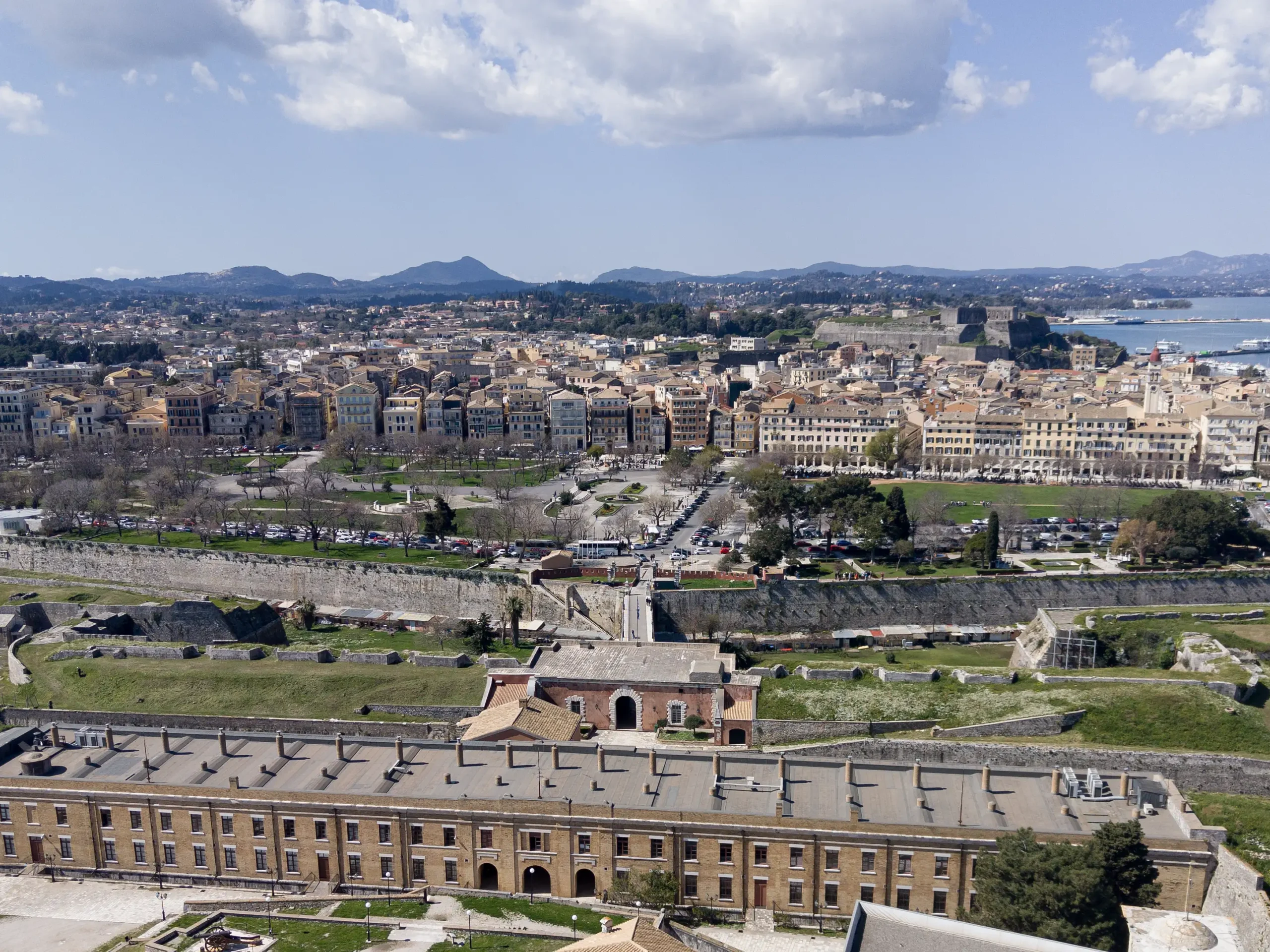



The Old Fortress is Corfu’s trademark. It is a true architectural marvel of fortification and perhaps the island’s most popular attraction. The Old Fortress has a long history, dating back to medieval times, a fact that is still evident to this day. This castle-town has played a pivotal role in the life of Corfiots, offering them shelter in times of turmoil and wars. The present-day does not find the Old Fortress in the best possible condition. Nevertheless, a large number of tourists and locals alike rush to visit it every day to either delve into the history of Corfu or take a relaxing stroll. Of course, the history of the Old Fortress is such that a single visit is not enough to cover its entire extent.
Taking a step back, we should refer to the history of this unique Fortress. Its first habitation takes place in the 6th century when the survivors of the barbarian raids on Paleopolis took refuge on the peninsula east of the present-day city of Corfu to save themselves. Gradually, the fortification of the peninsula took place, which during the Byzantine period was named Korifo because of its two peaks. The eastern peak was fortified first, with the Venetians fortifying the western peak. The Fortress slowly acquired its present form once the other fortification works were completed, part of which was the opening of a moat at the western end of the peninsula to turn it into an island. This channel is now known as the Contrafossa. Of course, the French and the British diversified the fortifications until the mid-19th century.
Today, the Old Fortress is characterized by the two enormous bastions of Savorgnan and Martinengo, located to the left and right of the bridge leading to the gate of the Fortress. The visitor cannot help but notice the impressive land tower, on which stands the oldest lighthouse of the modern Greek state, and the Cross, a trademark of the Fortress. The wider peninsula of the Old Fortress is home to many historic buildings, some still in use today. In the southern part, the Church of Agios Georgios stands imposingly, designed in the Georgian style but reminiscent of an ancient Greek temple in the Doric style. The church was built around 1840 and is still preserved today. Another essential building, located on the north side, is the music department of the Ionian University and part of the former barracks of Paschaligou. This building is estimated to have been built in the 18th century, forming a significant part of the city’s defense mechanism.
The Old Fortress has played a catalytic role both in the history of Corfu and in the history of the whole of Europe. Especially during the Venetian occupation, when “The Most Serene Republic” was called upon to protect its territories, Corfu was one of its most vital bastions. Moreover, there are many times when the Old Fortress was called and faced sieges, with the most important and best known of all the siege of 1716. Even in modern times and during the Second World War, the Fortress offered shelter to the island’s inhabitants during bombardments, proving in practice the high importance of its existence.
Today, apart from the music department of the Ionian University, the Old Fortress houses the Public Library, offices of the Corfu Antiquities Tax Office, and the Corfu Sailing Club. At this point, it should be mentioned that the Old Fortress has countless areas that used to be of defensive importance but are no longer used and are not open to the public. The complex of the Old Fortress is a truly unique example of fortification art, unique in the world. It is no coincidence that it has even contributed to the adjectives that have been attributed to Corfu from time to time, such as “Citta Fortezza” (fortress city) and “Terrible” (terrible), because of its dazzling and impactful fortifications.
In conclusion, the Old Fortress is an essential destination for all Corfiots and visitors, being inextricably linked to Corfu and its history.