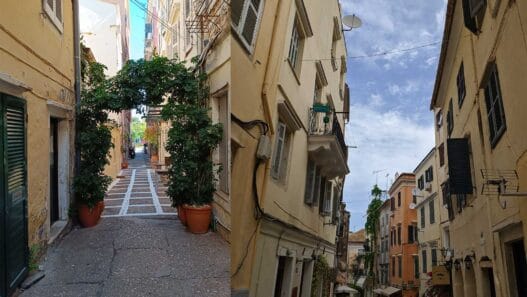



The island of Corfu has a long history, influential architecture, unique customs, and traditions. Corfu is known worldwide for its natural beauty and its stately old town. However, the most significant thing Corfu is well-known for is Easter. This period is extraordinary for both the island itself and its inhabitants. Corfu Easter offers unsurpassed emotions to those participating in the dew and religious ceremonies.
The Easter festive season in Corfu begins as early as Lazarus Saturday. On that day, the carols of Lazarus are sung, and a song is performed with the aim of the groups of children to collect tips, much like in other Christian holidays. Palm Sunday, or ‘Vayione’ as it is referred to on the island, officially marks the beginning of the Easter season. On the day of the feast, a procession of the Tabernacle of St. Spyridon is held in commemoration of the miraculous help that led to the relief from the deadly plague epidemic of 1629. The biggest procession of the year is accompanied by the 18 philharmonic bands of Corfu in a glorious yet solemn ceremony.
The first three days of Holy Week mark the gradual culmination of events. Everyone uses both Holy Monday, Holy Tuesday, and Holy Wednesday to make the final preparations. The whole city and the countryside are moving at a brisk pace, giving the feeling that something important is about to happen. Moving on to Maundy Thursday, apart from the usual religious and ecclesiastical ceremonies, an uncommon phenomenon takes place in Corfu’s old town. The three philharmonic bands perform the so-called rehearsal general, the last rehearsal before Good Friday, with mournful marches. Crowds gather around the buildings housing Palaia, Mantzaros, and Kapodistrias to listen to and enjoy these unique performances.
Good Friday is perhaps the most solemn day of the year for Corfu. All of the island’s churches, both in the town and in the countryside, carry their epitaphs accompanied by sections of philharmonic bands. Specifically in Corfu town, one can watch from 12:30 to 22:15 more than 30 epitaphs. The most important is the epitaph of the Holy Cathedral, which is the last to go around, accompanied by all three philharmonic bands of Corfu Town. The mournful marches performed by the hundreds of musicians make the setting particularly solemn, full of awe and emotion. In particular, the Kapodistrias Philharmonic Orchestra performs the mournful elegy “Sventura” and Chopin’s “Funeral March”. The Mantzaros Philharmonic Band performs the funeral marches “La Madruga” and “Aranjuez,” as well as the one by G. Verdi. Finally, from the Old Philharmonic, you will hear the mournful march “Descending to Hades” and one of the most famous and beautiful works, Albinoni’s “Adagio.”
The solemn night of Good Friday is followed by Good Saturday. The day begins as early as 06:00 in the morning, with the re-enactment of the earthquake after the Resurrection of the Lord. This unique service takes place in the Holy Church of the Most Holy Theotokos Faneromeni (Virgin Mary of the Strangers) in the Square of Saint, with the help of percussion instruments from the Old Philharmonic Orchestra.
The procession in honor of Saint Spyridon is scheduled for 09:00. This ceremony is the oldest ceremony that has been found in Corfu since 1553 and takes place in memory of the salvation of the island from the siege, with the miraculous help of St. Spyridon. This procession is particularly cherished by all Corfiots as it is marked by solemnity and devotion. The three Philharmonic Orchestras of the city perform unique pieces and add a vital note to the proceedings. In particular, the Kapodistrias Philharmonic performs an arrangement of the funeral march from Beethoven’s “Heroic Symphony,” as well as the funeral march “Destiny.” The Mantzaros Philharmonic Orchestra plays the popular “Calde Lacrime” (Hot Tears) by C. De Michelis, as well as “The Kingdom of Pluto.” Finally, the Old Philharmonic Orchestra performs the well-known “Amleto” by Franco Faccio, a piece of unique beauty.
The unbearable atmosphere of mourning and sorrow gives way, just a few minutes after the end of the procession, to the unexpected and joyful news of the First Resurrection. At 11:00 a.m., perhaps Corfu’s most famous tradition takes place, the throwing of the boots. Crowds of people gather at Pentofanaro and Liston to watch this unique spectacle. Tradition says that the custom has its basis in a passage from the Gospel, which says, ‘Thou Lord, raise me, that I may crush them as vessels of chaff.’ Of course, this glorious event could not be without music and, more specifically, the joyful march “Do not be afraid Greeks,” which echoes throughout the city’s canteens. At the same time, in another part of the historical center and more specifically in Pinia, the custom of the Mastela takes place, different from anything you have ever seen.
On the evening of Holy Saturday, the celebrations culminate in the Upper Square, specifically at the Bandstand, where the Resurrection is celebrated. Thousands of lit candles, hundreds of fireworks, and joyful melodies turn night into day and give the message of the Resurrection of the Lord. The Corfiot Easter gradually comes to an end on Sunday when the traditional services are held, always in conjunction with the Greek and Corfiot tradition of baking the “Obelia.” This unique period for the island is perhaps the ideal time to visit it. So, apart from this unique experience, you will also have the opportunity to get to know better the culture of Corfu through the traditional flavors, such as tsilichourda, which is a variation of the well-known cooking, but also the traditional ginger beer. Corfu Easter, with its traditions, customs, music, and smells, is undoubtedly an experience of a lifetime, which everyone should experience.