


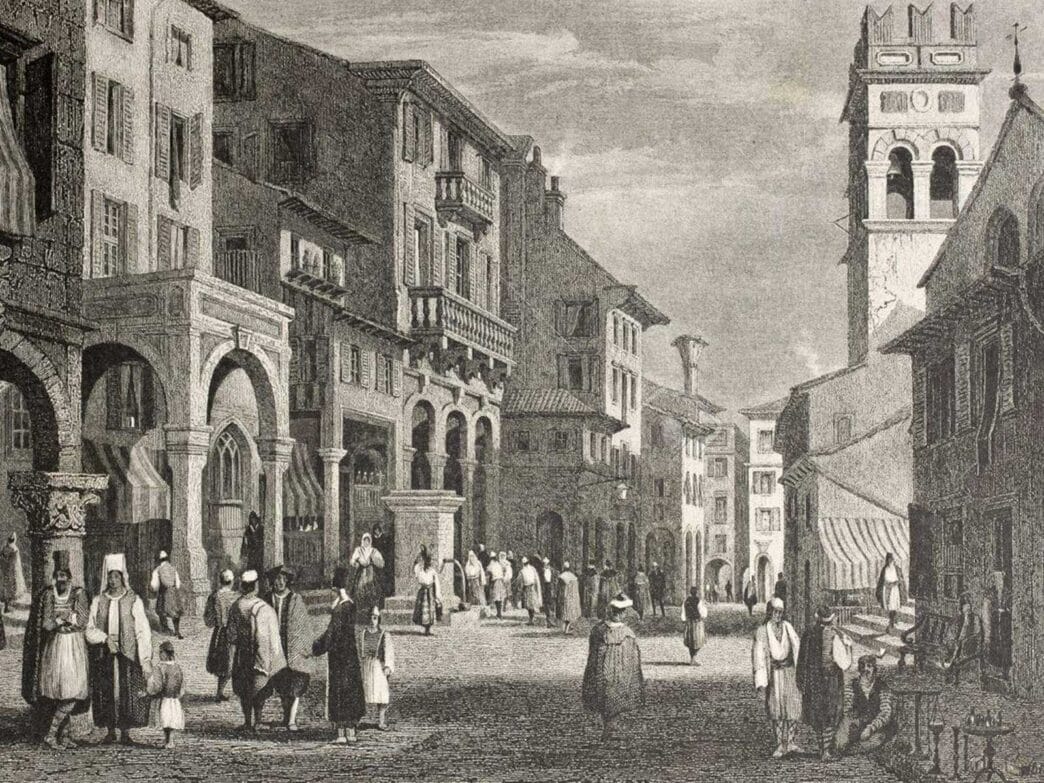
One aspect of Corfu’s history and culture that is particularly well-known is the local dialect. Both the inhabitants of the city and those of the villages and the countryside in general have for centuries adopted a distinct linguistic idiom, which is a mixture of Greek and Venetian Italian. Corfu had a direct link with and was an active member of the Greek world since antiquity. The vast majority of its inhabitants were Greek-speaking until the end of the rule of the Despotate of Epirus in the area when Corfu passed into the possession of the Angevins of Naples. In the following years, many Latins settled on the island, a process that continued during the Venetian occupation.
Thus, the population of Corfu consisted of Venetians and other Europeans, to a large extent, from the beginning of the 16th century. Indeed, combined with the fact that the Greek-speaking population was only 60%, the need for immediate and effortless communication with the Venetians was imperative. Consequently, words were adopted, which, with the appropriate paraphrases, became the Corfiot idiom. The Corfiot dialect was enriched with elements of Greek immigrants from the Peloponnese, Crete, and Cyprus and, over the years, created a whole system that stands to this day, not so intense, but undoubtedly present. An ideal example of the Corfiot dialect can be found in the famous “Petegoletsa.” Petegoletsa are improvised theatrical performances that are performed in the street during Carnival and are composed of texts written in the Corfiot dialect, often in an exaggerated way. The singing nature of this idiom, a characteristic again derived from Italian, and the strange words provoke interest and ridicule, elements that keep the tradition alive and the Corfiot dialect dear to all Corfiots.
At this point, it is worth mentioning that some phrases of the Corfiot dialect are used to a large extent even today, as they replace other, more common ones. For example, “mou kastike” is used like the corresponding “I thought that”. In addition, “to ore” is equivalent to “there it is” when indicating an object or something similar but emphasizing the suggestion. There are still many words used when describing everyday things or processes. The best-known example is perhaps the word “libretto” which describes closing the shutters halfway, just like a half-open book. A similar usage is the word “averta” which replaces “wide open” or “of large quantity,” in various sentences. In any case, it is a fact that such words are used in the spoken speech of Corfiots, even of the younger generations, as if they were regular words of the official Greek language. Of course, many of these words have crossed the small borders of Corfu and have been adopted to a certain extent in the rest of Greece, which proves the fluidity and greatness of the spoken language.
Continuing, it is worth mentioning that more than ten thousand Corfiot words and phrases are found written in books of older times and even in notarial deeds, which proves their widespread use throughout the island. Of course, even between the town and the rural villages, there are distinct differences. The example of many villages in both the northern and southern complexes is typical, as they retain the characteristic timbre and singing nature of the dialect even if they do not use its corresponding words and expressions.
In conclusion, we must once again stress the value of preserving the Corfiot dialect as a living organism that links tradition and the past with the present and its needs. The idioms of each place, including Corfu, help the inhabitants to get to know the place, its customs, and traditions better, resulting in the development of knowledge and spirit.