


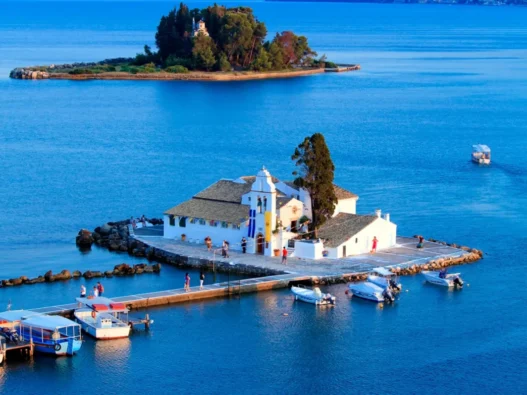
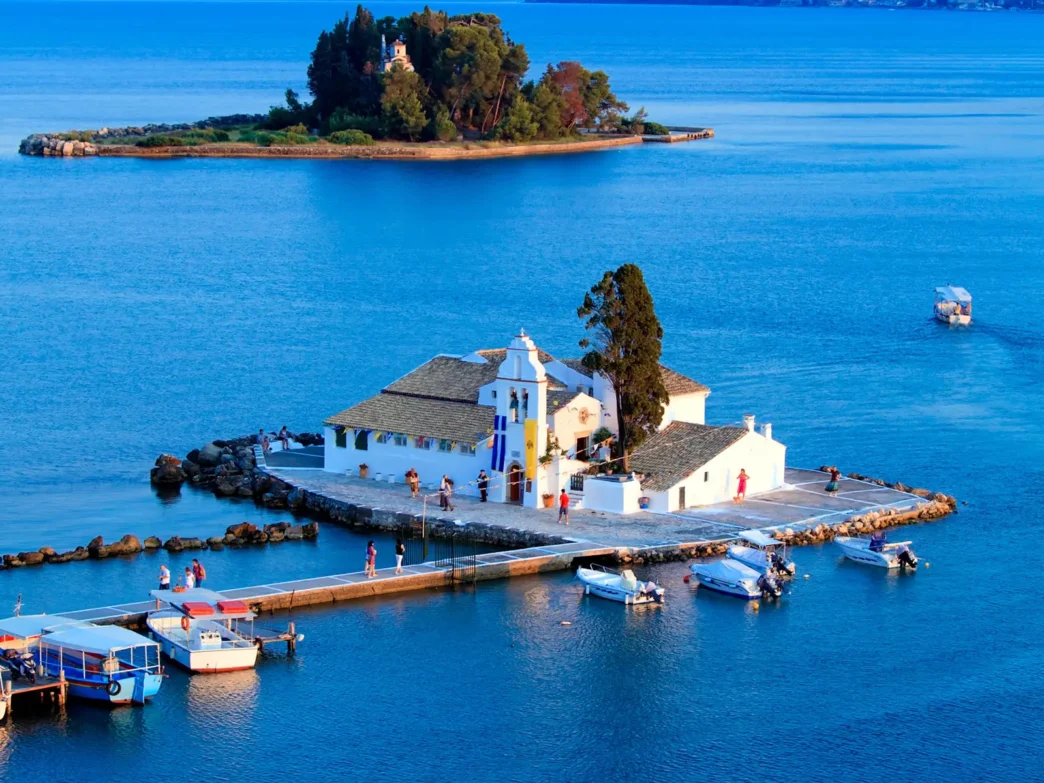
Kanoni is probably the most photographed location in Corfu. The enchanting scenery is created by a distinct triangle consisting of the famous Pontikonisi (Mouse) Island, the monastery of Panagia Vlacherna, and the Corfu airport, standing in a distinctive area. The broader area of Kanoni, also known as Paleopolis, has a long history dating back to ancient times. Today, Kanoni is synonymous with tourism, enjoyment, and relaxation, offering services that meet all needs.
Kanoni is located about 5 km from the center of Corfu town at the southernmost tip of the Paleopolis peninsula. The area’s name comes from a genuine cannon placed by the French in 1798 as part of an artillery battery, which is still there today, becoming a landmark of the island. Usually, when Corfiots refer to Kanoni, they include the monastery of Vlacherna in the area. This monastery, dedicated to the Virgin Mary, seems to have been built in the 17th century, while it operated until the late 80s as a nunnery.
Of course, we could not fail to mention the world-famous Pontikonisi (Mouse) Island. This small tree-covered rocky islet hosts a church dedicated to the Transfiguration of the Savior on its top, its construction dating back to the 11th century. There are many theories concerning the name Pontikonisi. One of them proclaims that the island got the name either because of its shape or because of the many mice that live there. The other version states that in the 10th century, Pontian monks fled to the island, so the original name “Pontionisi” was paraphrased to the present-day Pontikonisi. This small island can be found in myths, legends, and art. The most obvious example is, of course, the popular song Kerkyra-Kerkyra, performed by the Corfiot actress Rena Vlahopoulou in the film “The Countess of Corfu.” It is also said that Mouse Island inspired the Swiss painter Arnold Böcklin to create a series of paintings entitled “Island of the Dead.”
In making a small historical review, we will examine the broader area of Kanoni, such as Paleopolis, the ancient city of Corfu that was inhabited from the 8th century BC by Corinthian colonists. Paleopolis extended in a zone south of the present-day airport “Ioannis Kapodistrias” up to Kanoni, with some remains of the then highly developed settlement still surviving today. Ancient Corfu experienced remarkable development, reaching the point of minting its own coin, the Phoenix while having the second largest and most powerful fleet in Greece after Athens. Paleopolis was abandoned during the medieval years after many barbarian raids, with the inhabitants finding shelter in the present-day Old Fortress. However, there are still some remnants of civilization, such as the Paleochristian church of St. Corfu. Modern Kanoni and the wider area is a quiet suburb of the town, ideal for relaxing walks. The historical-architectural monuments, the beautiful nature, the continuation of Mon Repos Park, and the excellent view make up a unique setting ideal for a visit.
In the modern era of tourism, Kanoni is one of the first choices for visitors to Corfu. The area hosts luxury hotels, restaurants with Corfiot and other flavors, and bars for entertainment and relaxation, always with a view of Vlacherna and Pontikonisi Island. Moreover, Kanoni, and more specifically, the area of Vlacherna, offers a unique experience to all visitors. The pedestrian bridge that connects Kanoni with Perama is an ideal spot for watching and photographing the planes landing at the airport, passing just a few meters above the ground. There is also the possibility for those who wish to visit Pontikonisi Island with the help of the boats that make this small but beautiful ride.