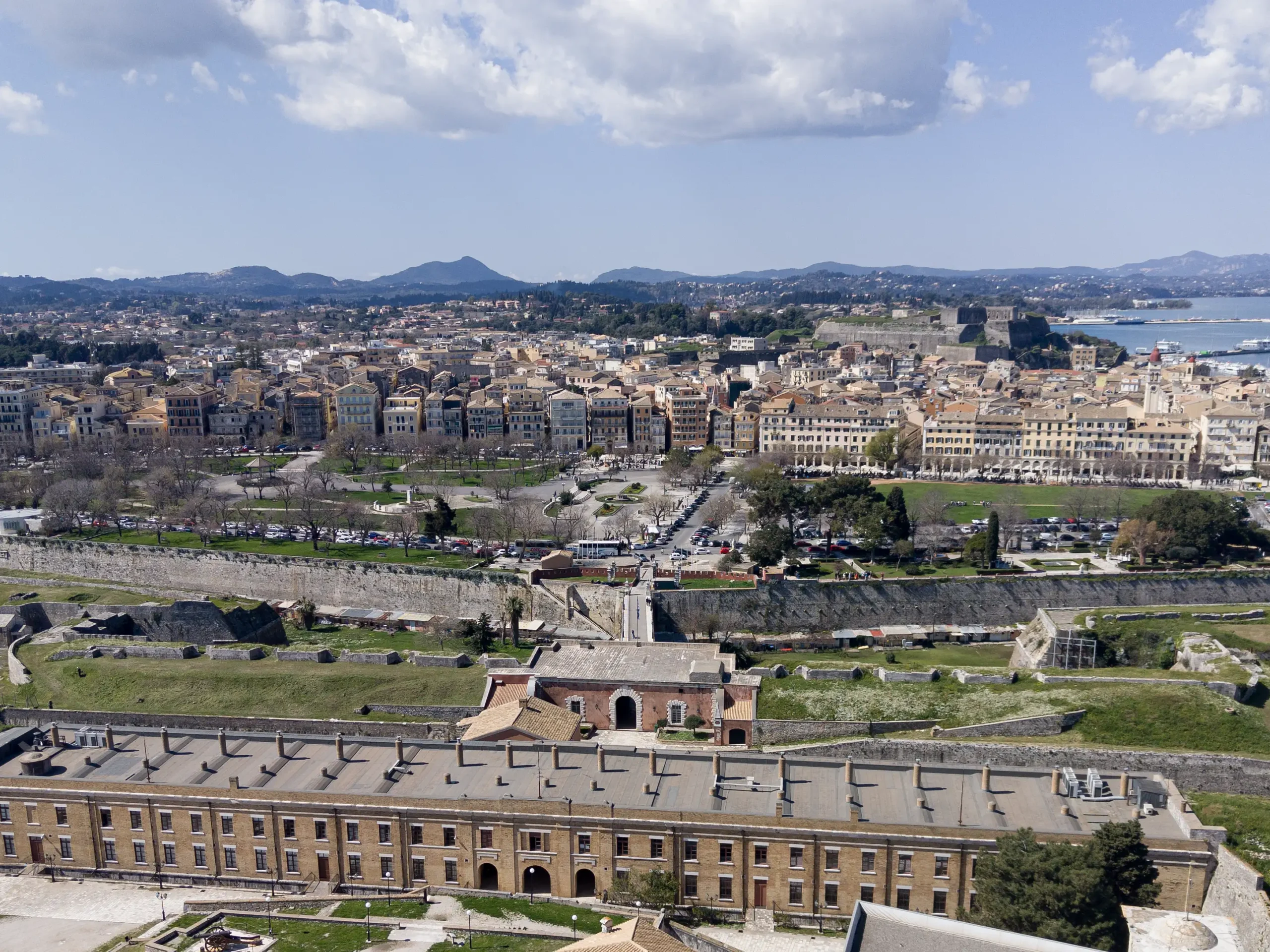



The Palace of Archangel Michael and St. George is a genuinely unique 19th-century architectural structure that was a palace and now functions as a Museum of Asian Art. The Palace is located in the northern part of the Spianada square and stands out for its particular size, architecture, and the two impressive arches that adorn it on the left and right.
The largest and most important building of the period of Ionian State, the Palace was built by order of the British High Commissioner Sir Thomas Maitland. Its construction began in 1816 and was completed in 1864 when Corfu became part of the then-newly established Greek state. Sir George Whitmore, the architect who built the building in Regency style, with an emphasis on Neo-Palladianism, was in charge. The Palace is characterized by the fundamental features that one would find in similar buildings of the period, but these were varied many times due to financial pressure and lack of time. As far as its reconstruction is concerned, many Corfiots are aware of the fact that stones from Malta were used for the construction of the building complexes.
Furthermore, it is worth noting that the central part, above the cornice, is decorated with works of the Corfiot sculptor Prosalendis and, more specifically, with reliefs of the seven islands of the Ionian Sea. Moreover, the middle part was decorated with the horn of Amalthea, as well as the statue of Britain, mainly British symbols. The building complex housed, from time to time, both the Ionian Senate and the Ionian Parliament, two institutions that were symbols of the self-reliance of the Ionian Islands.
Special mention should be made of the two large arches located to the left and right of the main building. The Archangel Michael’s and St. George’s arches are points of reference for locals and visitors, contributing to an exquisite and unique setting. The former British Palace was used during the First World War as a coordination and emergency building. Of course, it is a fact that over the years, it was neglected and developed problems that are still being addressed today.
Perhaps the most vital element worth mentioning is that the Palace is now a unique museum of Asian Art. This one-of-a-kind museum was based on the collection donation of Grigorios Manos. A visit to the museum offers an excellent experience and an approach to cultures very different from the Greek, but also the European philosophy in general. In the museum, you will have the opportunity to admire remarkable exhibits from the highlands of Tibet to the southeastern coast of China and Japan. More specifically, the museum features over 15,000 items of Asian art from countries such as India, Pakistan, and Thailand.
In addition to visiting the museum, the Palace complex offers the opportunity for relaxing walks. The obvious choice is to stroll in front of the building’s imposing façade and past its beautiful gardens. Of course, we could not miss the hidden “Garden of the People”, a beautiful, quiet garden with views of the Old Fortress, Faliraki, and the island of Vido. “The Garden of the People” is an excellent choice for those who wish to walk in nature and discover even the most well-hidden corners of Corfu Town. At the back of the Palace, the Scouts of Corfu are housed, and right next door is Faliraki, an idyllic location ideal for drinks, local food, and even swimming.
In conclusion, the Palace of Archangel Michael and St. George is an irreplaceable landmark of the old town of Corfu and an integral part of the island’s history. The place where it is located is ideal for wandering and exploring an era of history that has many different characteristics from ours and that we hardly ever encounter anymore.