


Corfu is one of Greece’s islands with a long and significant history. The island’s history begins in prehistoric times when the first signs of habitation were recorded. Throughout the whole area of Corfu, fossils have been found that testify not only to the existence of human activity but also to the island’s completely different biodiversity.
Of particular interest is the region around the present-day village of Agios Matthaios. More specifically, in an area stretching from the present-day Gardiki to Korission lagoon, traces of life have been found as early as the Paleolithic period, with scrapers, various spikes, and flint fragments being the leading evidence. Also of distinct importance are the fossils of multiple animals that inhabited the wider area of Corfu, such as those of deer, other small mammals, and even hippopotamuses.
With the passage of time and the global establishment of the human species, Corfu developed and became a place of particular geographical importance in Greece. The island is identified as that of the Phaeacians, as Homer mentions in the epic of Odyssey. That’s when the emblem of Corfu, still in use today, came into being. The “Apidalos Naus” (“Unruddered Ship”) was the symbol of the naval skill of the Phaeacians.
One of the most vital periods for the island began when the Corinthians decided to colonize it at the end of the 8th century BC. Taking refuge on a small peninsula south of the present city, they founded the well-known Paleopolis. The Corfiots gradually broke ties with the Corinthians, gaining their independence, having even recorded the first naval battle between Greeks in 664 BC. Corfu developed distinctly in the following decades, creating a strong economy and minting its own currency, the Phoenix. According to Thucydides, the island’s prosperity was such that it was able to maintain the largest fleet in Greece after Athens, with 110 triremes in its fleet. Of course, the development of Corfu was one of the many reasons for the Peloponnesian War.
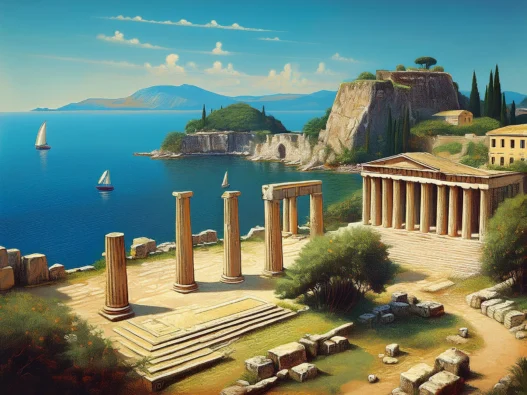
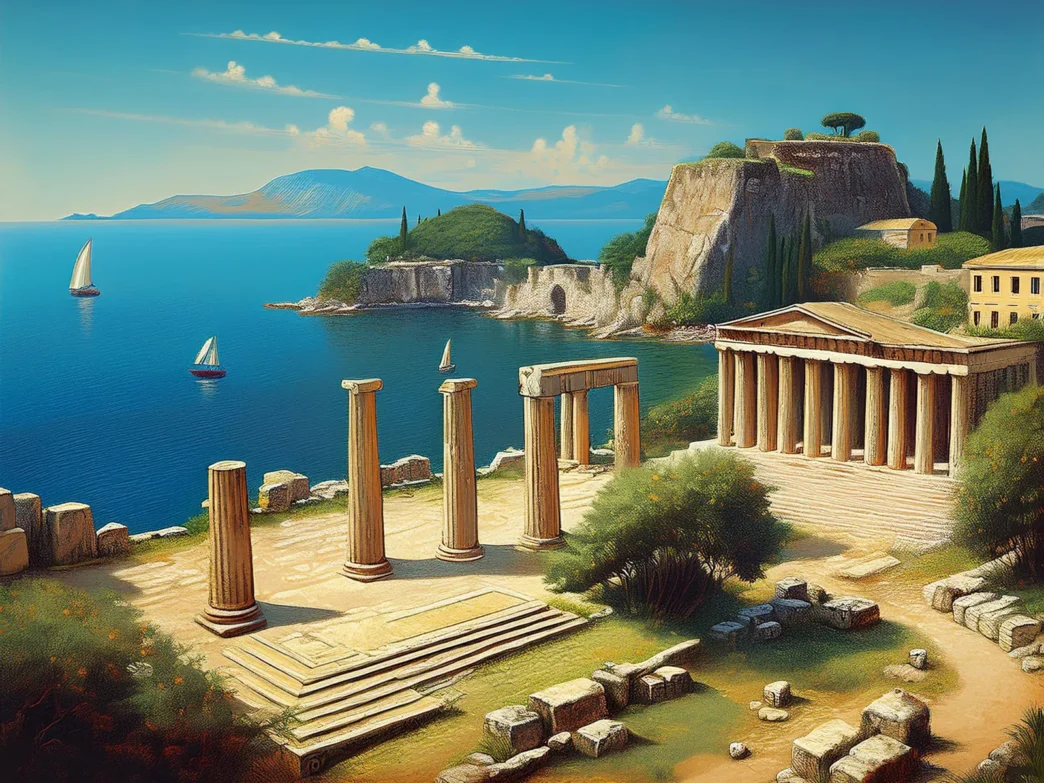
The ancient city of Corfu called Paleopolis, also known as Hersoupoli, extended at a distance from the present airport, up to the area of Kanoni. This settlement had two harbours, the Ylaiko port to the west and that of Alkinoos near the area of Anemomilos. The archaeological finds of the area. They enable us to observe and explore the culture, architecture and art of the period. The temples dedicated to Hera and Artemis are perhaps the most important ruins, along with the monument to Menekrates. Gradually, part of the northern part of the island was also inhabited, in the areas of Rhoda and Acharavi, indicative of the power of ancient Corfu.
The gradual turmoil of ancient Corfu began shortly after its conquest by the Romans in 229 BC. For several more centuries, the island would experience turbulent periods, as the Roman rule had many consequences. The city would experience destruction and reconstruction due to the internal conflicts of the Roman Empire. This period also marks the development of modern-day Kassiopi, a settlement of particular geographical importance. Corfu was Christianized in the first half of the 1st century AD by the disciples of the Apostle Paul, Jason, and Sosipatros. Gradually, Christianity became entirely prevalent on the island, thus completing a primary phase of developments that marked the end of the broader Archaic era of Corfu.
The signs of the past formed the basis for the island’s future development. Corfu experienced great turmoil in the following years, which led to some of the most important changes in the island’s history. Nowadays, ancient Corfu is part of the island’s history, but also part of the everyday life of many residents, as many of its remains are found in the urban fabric of the area that is still called Paleopolis, reminding us of Corfu’s past and long history.