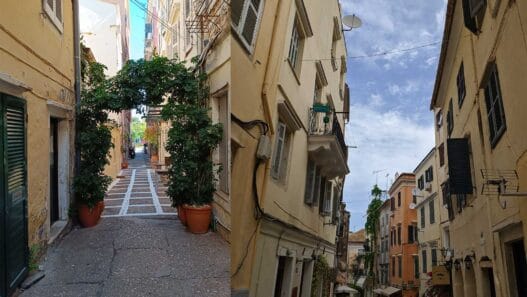



The Holy Church of Agios Spyridon in Corfu Town is one of the most important monuments on the whole island. Built in one of the most central spots of the old town, it is hidden behind the narrow alleyways and the tall old houses. The church is dedicated to the patron saint of Corfu, Agios Spyridon, for whom Corfiots still maintain a great love to this day. Besides, it is no coincidence that the Saint is at the center of the celebrations of the whole island several times a year.
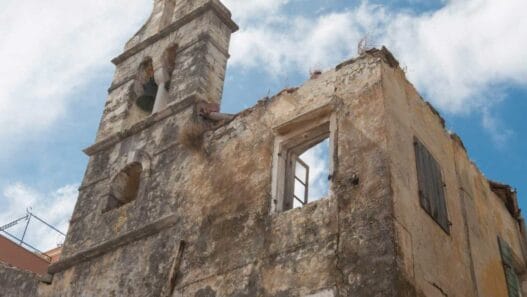
As for the church itself, it was built by the Voulgaris family of Corfu in 1589, adopting the form of the Ionian Basilica. A feature that one will immediately notice when observing it is the extremely simple exterior decoration, which contrasts perfectly with the church’s interior. The decoration includes significant artworks of highly recognized Corfiot painters, such as Spyros Prosalendis and Panagiotis Doxaras. Of particular beauty is the iconostasis, made of marble from Paros. Equally important is the bell tower of the church, which is characterized by the red dome on top and has a height of 40 meters. The clock, which is visible from all sides of Corfu’s old town, is similar to that of St. George of the Greeks in Venice.
Saint Spyridon was the bishop of the province of Trimythus in Cyprus and died in 358 AD. His holy relics remained indestructible until about the end of the 7th century AD when they were transferred to Constantinople. The relics of the Saint arrived in Corfu a few years after the fall of Constantinople to the Turks, where it remains to this day. At this point, it is worth noting that the relics, upon their arrival in Corfu, were not initially placed in the current church. They were first housed in the Church of St. Athanasios, then transferred to the Cathedral of Archangel Michael in Campielo. In later years, the relics of Agios Spyridon were transferred to the church in his honor in the area of San Rocco, from where they ended up in their present location after a short visit to the Church of the Agioi Anargyroi in the Old Fortress of Corfu, for security reasons, during the siege of 1537.
The presence of Agios Spyridon on the island has proved miraculous many times over the years. Some of the most famous miracles of the Saint are the relief of the island from a plague epidemic in 1629 and 1673. However, perhaps the saint’s most famous miraculous intervention took place in 1716 when Corfu, under Venetian rule, was under siege by the Turks. Many ordinary citizens, as well as prominent military men, attribute the salvation of the island to Saint Spyridon, who through an enormous storm, managed to shatter and drive away the Turkish troops during the most vital turning point of the siege.
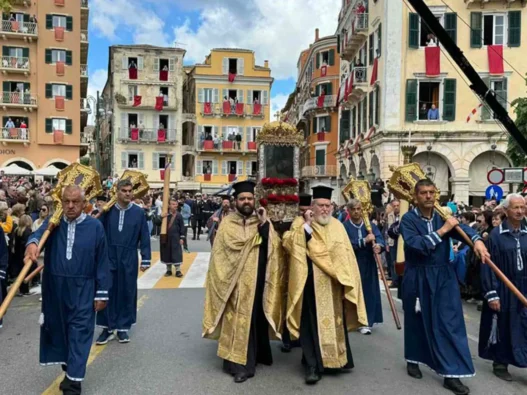
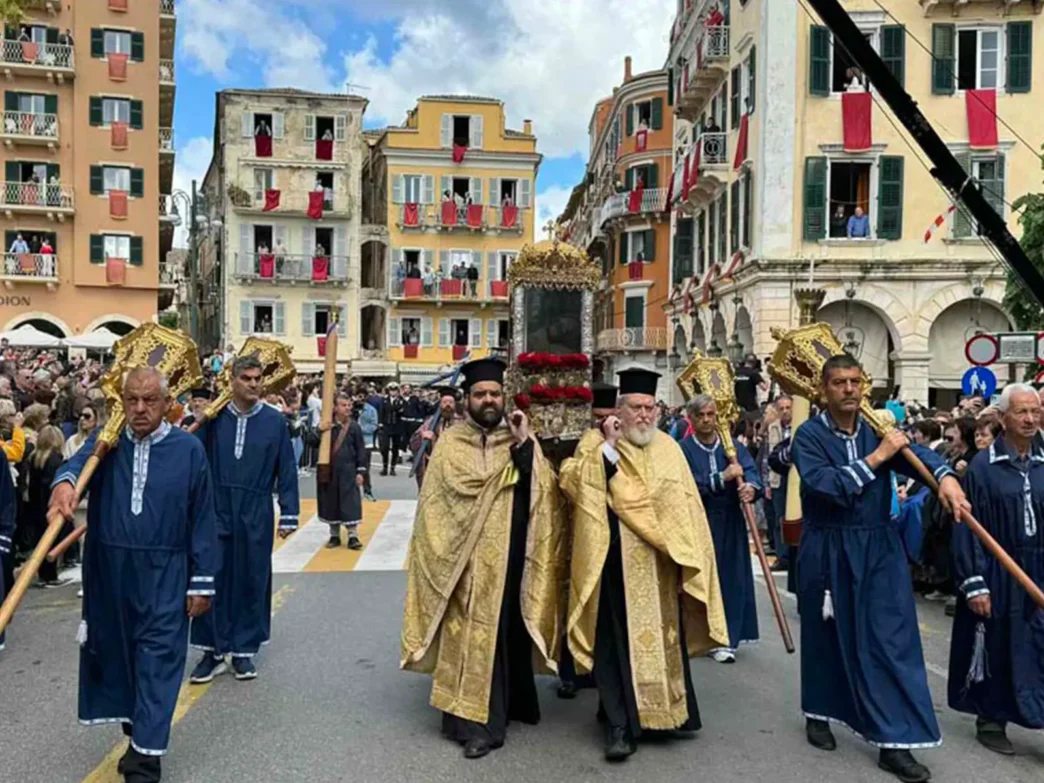
The people of Corfu honor the patron saint of the island many times a year with magnificent processions in which the philharmonic bands of both the town and the villages participate. More specifically, the relics of the Saint is processioned on Palm Sunday, Holy Saturday, the 11th of August, the first Sunday of November, and also on the 12th of December, when the memory of the patron is celebrated.
The inhabitants of the island have developed a special relationship with Agios Spyridon, a fact that can be understood through their everyday lives. In particular, in earlier times, the name of the Saint was synonymous with the quest for redemption and compassion, even justice. The Saint’s Shrine itself was in the past the object of bail, even during legal disputes.
On this day, the Holy Church of St. Spyridon receives hundreds of visitors daily from all over the Orthodox world and beyond. The Saint is constantly remembered as a living and eternal protector of the island and the people of Corfu.